Corriere della Sera: Michelangelo Pistoletto remembers his father Ettore Olivero by Paola Stroppiana
May 24, 2026
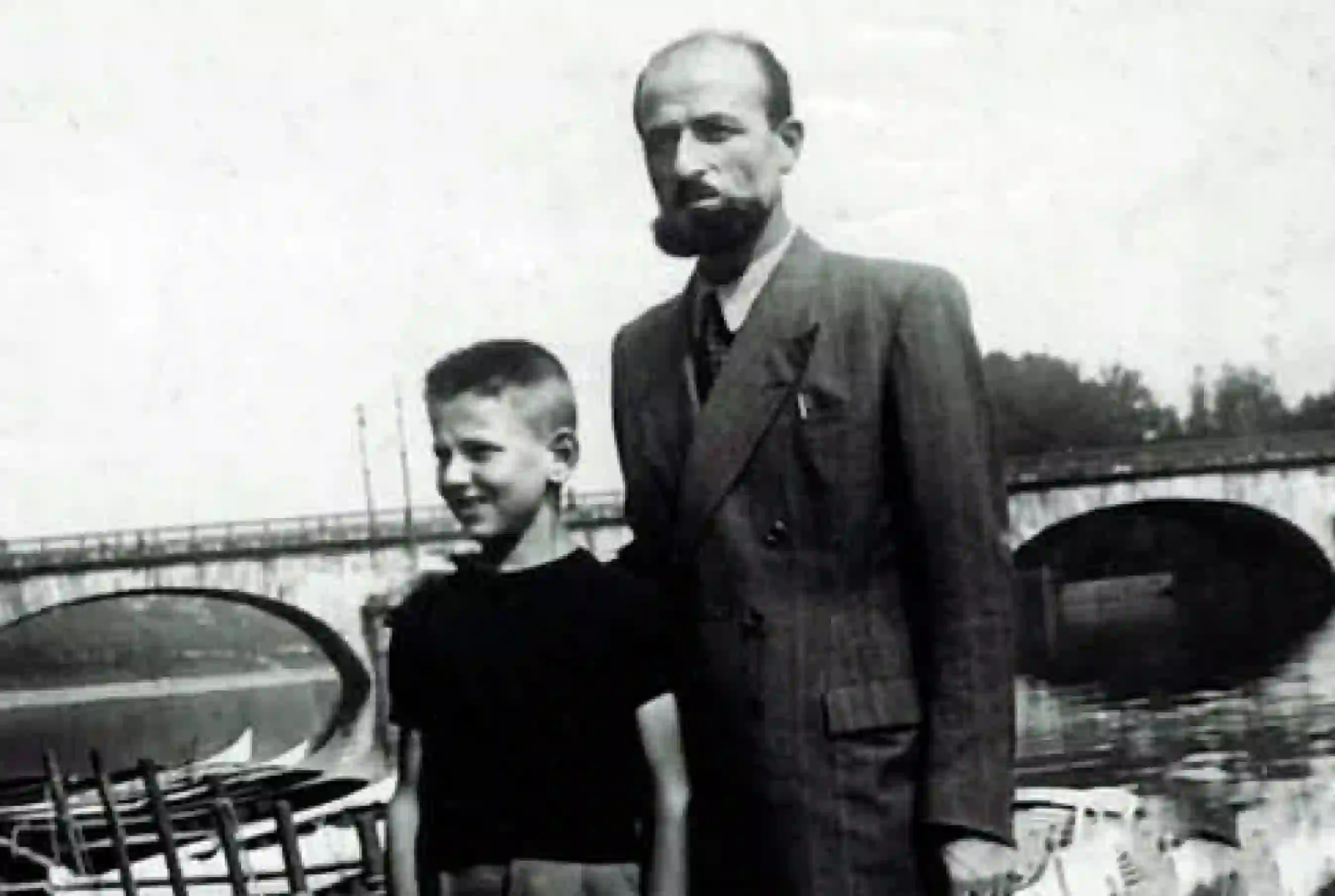
“It was my father that forced me to enter the mirror: it shatters time. I was his student, then he became me. If he hadn't been deaf, I wouldn't exist. At fourteen, he taught me drawing, the relationship with self-portraiture, and copying from life. I suggested he add a mirror-polished container to a painting: thus, without knowing it he created his self-portrait."
We meet with Maestro Michelangelo Pistoletto (Biella, 1933) in a landscape of remarkable beauty, in the spaces of Cittadellarte - Fondazione Pistoletto, an industrial archaeology complex in the former Trombetta Wool Mill, located along the Cervo River in the town of Biella. Founded by the artist in 1998, this immense creative laboratory, organized into numerous buildings designed for diverse functions such as exhibitions, workshops, artist residencies and hospitality, it was conceived as a Renaissance-inspired citadel—it even includes the “Palazzo del Buongoverno”—capable of connecting creativity, education, politics, economics, spirituality, and social transformation.
A place that best represents Pistoletto's most extensive and radical work, a living organism in which art becomes a driver of collective responsibility and change. It is here in Cittadellarte that the maestro returns to reflect on the figure of his father, Ettore Olivero Pistoletto (Gravere, 1898 – Sanremo, 1981), a painter and art conservator trained in the Italian Academic figurative tradition and conservation techniques. This relationship has inspired several exhibition projects: from the generational comparison presented in 1973 at Gian Enzo Sperone's gallery, to the project realized with Giorgio Persano in 2008 with the exhibition "I coetanei" which built on the dialogue between mirrored works created by the Pistolettos, father and son, when they were both seventy-five years of age. This exploration was complemented in 2019 by the major exhibition "Padre e Figlio" (father and son) curated by Alberto Fiz. The Pistolettos collaboration is to be considered a tribute to the family dimension and a reflection on the genealogy of art, the transmission of knowledge, and the very possibility of abolishing, through the artwork, the separation between past and present.
Maestro, what is your first memory of your father?
It's a very ancient reminiscence, almost predating conscious memory. I remember the smell that permeated my father's studio, the wafts of oil paint and turpentine mixed with the incense my mother lit. I discovered Art through my sense of smell, my eyes, and even my sense of taste. My father painted still lifes, fish, game, vegetables: my mother cooked what he staged, so in a way, we nourished ourselves with his paintings.
What kind of man was Ettore Olivero Pistoletto?
He was born in Gravere, in the Susa Valley. As a child, he had meningitis and completely lost his hearing. I believe his entire artistic life stemmed from there: at school, he couldn't hear the teacher, so he looked out the window, where he glimpsed a small church adorned with frescos; he began copying those images. Sometimes I think my entire story is an extraordinary chain of events: if my father hadn't become deaf, perhaps he would never have painted, and perhaps I myself would never have existed as a painter.
It was precisely in Biella, in Trivero, that he met your mother, Livia?
My father was there because he was creating a cycle of works dedicated to the history of the art of wool making in the Middle Ages for Ermenegildo Zegna. He met my mother because she wanted to learn to draw and paint.
His painting remained distant from the avant-garde movements of the XX century?
There's a reason: modernity was also born through words, comparisons, and discussions between artists. My father, being deaf, remained outside of that revolution. He continued to devote himself to figurative painting and his work as a conservator, was particularly intense in the post-war period because he was asked to work on numerous ancient artworks owned by families forced to sell. I began helping him at the age of fourteen; it was my father who taught me how to draw and understand the relationship with self-portraiture and copying from life.
Yet, at a certain point, he felt that this wasn't his path?
Because of his deafness, he couldn't have a driver's license, and I acted as his chauffeur, accompanying him to the mountains where he painted his landscapes. In the meantime, I devoted myself to a few small paintings, but I felt no emotion. It was my mother, to whom I am extremely grateful, who said that the future lay in advertising: she enrolled me in Armando Testa's school in Turin, where for the first time I heard serious talk about modern and contemporary art and had the opportunity to study it carefully.
Do you remember the turning point?
In the early 1950s, I saw some works by Lucio Fontana in the window of a shop in Turin. People were shocked by his canvases with holes. I didn't fully understand those works yet, but I understood one essential aspect: if an artist manages to do something like that, it means he has a profound reason for doing it. So I had to find my own reason, too.
Is this where the self-portrait as a method of knowledge originated?
The only certainty was that I existed: I knew I existed because I could see myself. The self-portrait became a way of knowing myself; I began to create large, highly textured self-portraits. Then I understood that the material had to have a boundary, and that the boundary was my face. The self-portrait became the frame of the material.
How much influence did the training you received from your father have on this research?
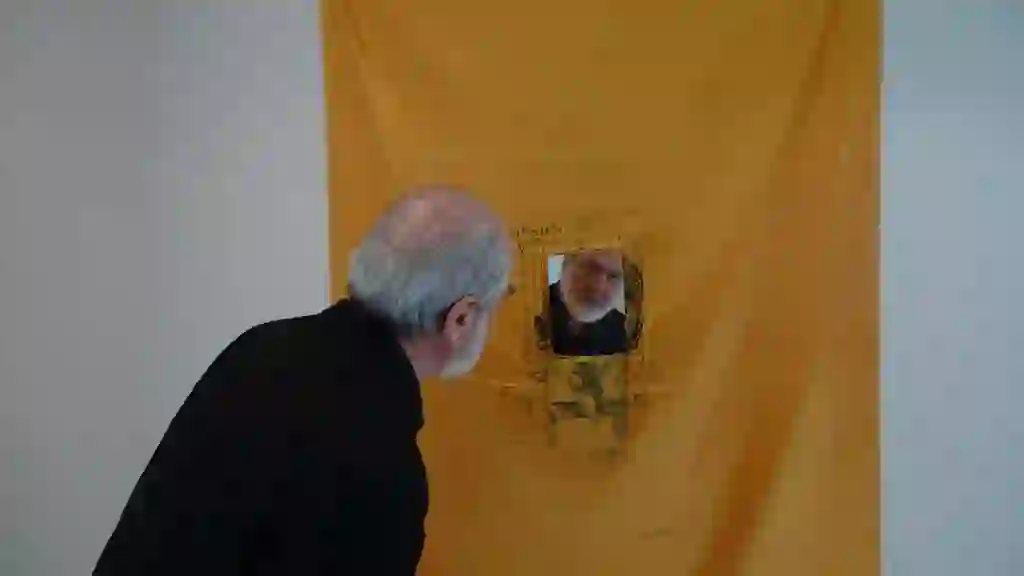
Very much. I come from a culture of goldleaf backgrounds, sacred art, and hieratic images. I painted icon-like figures on highly polished black surfaces: something decisive happened there, that surface began to reflect the world. Time, space, and the viewer's presence entered the painting. From there, at that moment the mirror paintings were born.
Over time, your artistic paths crossed again?
Yes. When I had achieved international recognition, I saw my father continuing to paint still lifes. I suggested he add contemporary objects to the paintings, and among others, I purposely included a mirror-polished steel container: thus, in painting it, he also unknowingly created his own self-portrait. I forced him to step into the mirror, the mirror that had allowed me to shatter the fourth dimension: the one of time.
This idea also permeates his concept of immortality?
Immortality is not something individual. It exists in transmission, in continuity, in the passage from one person to another. I have never considered my parents dead; they continue to live in what I do.
If you had to define your father today with a single image?
My father isn't behind me, he's within my time. I brought him into my artwork, and he brought me into his desire. At a certain point, our ages met, our images overlapped, our lives stopped belonging to two different people. I was his student, but then he became my student. My father became me.
Paola Stroppiana (Turin, 1974) is an art historian, journalist, and independent curator. She graduated with honors in Medieval Art History from the Faculty of Letters and Philosophy at the University of Turin, with a thesis on 15th-century sacred goldsmithing.
In recent years, she has dedicated much of her research to artistic jewelry and its historical contextualization in Italy and the international scene since the beginning of the XX century to the present. She has published several volumes on this topic, lectured at various institutions in Italy and abroad, and curated public and private exhibitions.
As journalist, she has written a weekly column for Corriere della Sera - Turin since 2024, focusing on history of art. She also interviews many leading figures.
Magazzino Italian Art co-founders, Nancy Olnick and Giorgio Spanu would like to thank Carmine Festa, Director of Corriere della Sera, Turin ed.