Altravoce: Boetti in the USA: The Global Artist of Multiplicity
May 20, 2026
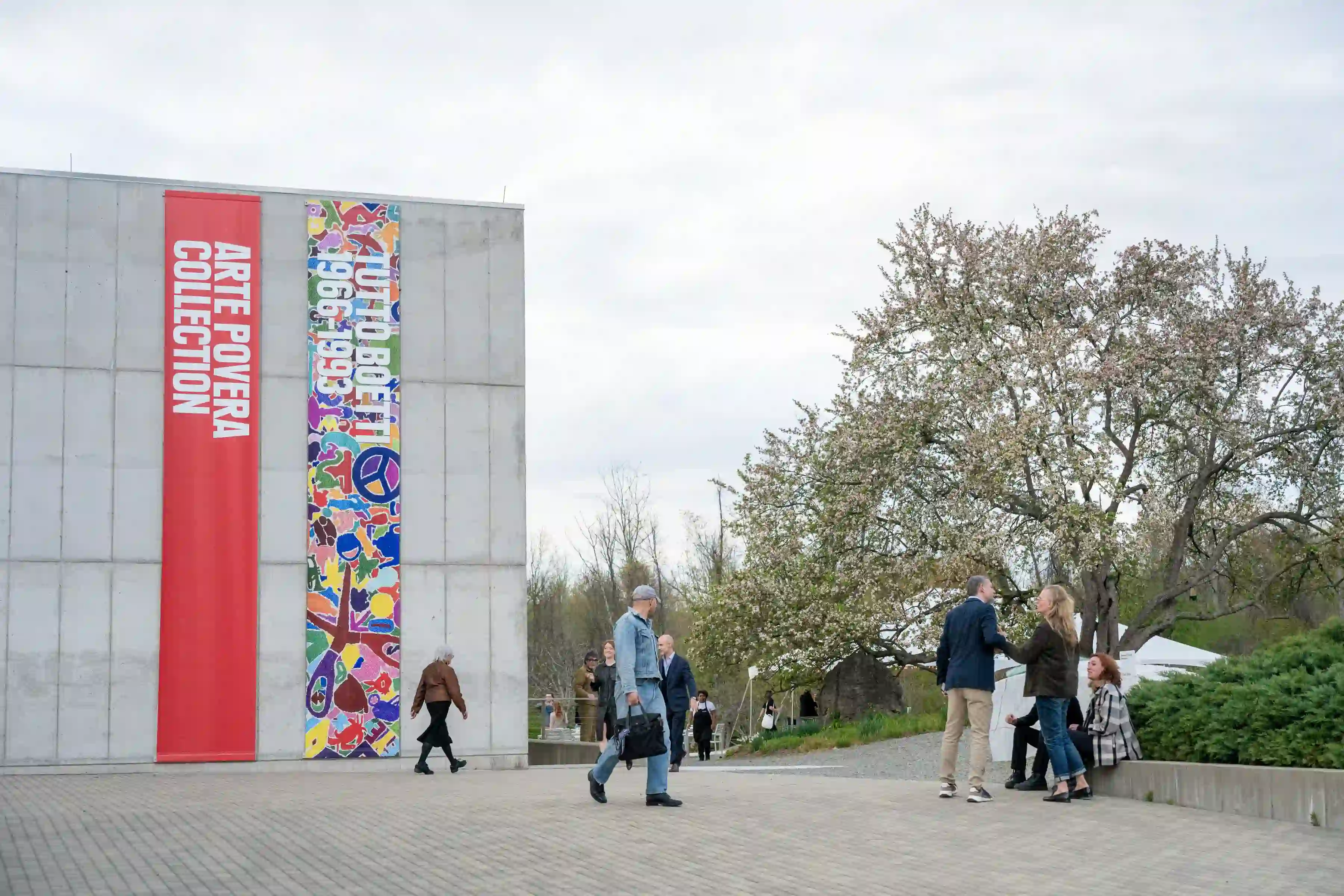
An invisible line connects Turin to Cold Spring, Kabul to the Hudson Valley—linking Alighiero Boetti’s mental geometry to the collecting fervor of Nancy Olnick and Giorgio Spanu.
It is a nomadic, intermittent line, defined more by crossings than by allegiances. “Tutto Boetti 1966–1993”—the major exhibition staged by MagazzinoItalian Art and curated by Nancy Olnick—is not merely a museum tribute; it is the reactivation of a poetic sensibility.
Boetti was the artist of controlled dissipation. He was the one who introduced the Eastern principle of “drifts” into Italian art—the idea that the world does not organize itself according to stable hierarchies, but rather through a proliferation of signs, coincidences, alphabets, maps, numbers, embroideries, and permutations.
Within the context of Arte Povera, he represents a fertile anomaly: not the energetic celebration of matter, but its mental evaporation. MagazzinoItalian Art seems the ideal setting to embrace this anomaly. Founded in 2017 by Nancy Olnick and Giorgio Spanu, the museum was born of a private passion transformed into a cultural geography. Nestled amidst the nature of the Hudson Valley—90 kilometers north of New York City—the site features two pavilions: the main building, designed by Miguel Quismondo, and the Robert Olnick Pavilion, designed by Miguel Quismondo in collaboration with the renowned Madrid-based architect Alberto Campo Baeza. The project possesses an almost monastic quality: concrete, silence, northern light, and spaces that do not impose themselves, but rather guide the visitor. Here, everything speaks of rigor—and, simultaneously, of love. An invisible line connects Turin to Cold Spring, Kabul to the Hudson Valley—linking Alighiero Boetti’s mental geometry to the collecting fervor of Nancy Olnick and Giorgio Spanu. A nomadic, intermittent line—one defined by crossings rather than by belonging. “Tutto Boetti 1966–1993”—the major exhibition presented by Magazzino Italian Art and curated by Nancy Olnick—is not merely a museum tribute; it is the reactivation of a poetic temperature. Here, everything speaks of rigor and, simultaneously, of love. Alighiero Boetti was the artist of controlled dissipation—the one who introduced into Italian art the “Eastern principle” of "drift": the idea that the world does not organize itself according to stable hierarchies, but rather through a proliferation of signs, coincidences, alphabets, maps, numbers, embroideries, and permutations. Within the context of Arte Povera, he represents a fertile anomaly: not an energetic celebration of matter, but its mental evaporation.
Over the years, Nancy Olnick and Giorgio Spanuhave built something rare: a permanent outpost for contemporary Italian art in America. Not merely a nostalgic annex of "Italianness," but a critical platform capable of demonstrating how post-war Italian visual culture reshaped the international lexicon of art.
THE MUSEUM
The major exhibition, “Tutto Boetti 1966–1993”, Curated by Nancy Olnick and staged at "Magazzino Italian Art"—the institution was founded by Nancy Olnick and Giorgio Spanu in Cold Spring, New York, in the Hudson Valley.
Above all, Arte Povera here ceases to be a historicized formula and returns to being what it was at its inceptionwhen activated by GermanoCelant: a gesture of freedom. Boetti, therefore, is a fitting choice—and no mere coincidence. More than anyone else, he embodied this very freedom. The exhibition at Magazzino opens with works from 1966—the original core of pieces first presented by Margherita "Christian" Stein in her historic solo exhibition in Turin in 1967. Here, the artist appears—even in his youth—already fully formed in his very irresolution. He does not seek a style; he seeks a “slippage”. Industrial objects—tape measures, pipes, light panels—are stripped of their intended function and transformed into enigmatic presences. “Triplo metro” (Triple Meter), “Asta di misurazione” (Measuring Rod), and “Mancorrente a squadra” (Right-Angle Handrail) are works that enact a subtle torsion of reality. It takes very little—a minimal displacement, an unexpected assembly—for the technical world to suddenly lose its functional innocence.
Boetti immediately grasped that art need not by inventing images, but rather subvert languages. In “Pavimento Luminoso” (Luminous Floor) from 1966, light ceases to be a mere optical phenomenon and becomes a physical presence. It acts as a perceptual threshold—an energetic carpet that absorbs the viewer’s body. Nearby, “Mazzo di tubi” (Bundle of Tubes) elevates industrial PVC to the dignity of a contemporary totem. Absent here is the Duchampian irony; instead, there is a kind of secular spirituality of the object. Even in these early works, the decisive theme of his artistic inquiry begins to emerge: the coexistence of order and disorder. Indeed, every work is born from a simple rule—one that, however, yields unpredictable effects. It is a combinatorial logic—almost Kabbalistic in nature—that would traverse the entirety of his artistic trajectory.
In the 1970s, this principle expanded further. Rome supplanted Turin. Nomadism took the place of industrial discipline. The artwork opened itself up to delegation, collaboration, and the diffusion of authorship. “Da mille a mille” (From a Thousand to a Thousand), created in 1975, serves as a prime example: eleven sheets of graph paper entrusted to assistants, who were tasked with completing the work through their own autonomous variations. Here, the artist relinquished absolute control; the artwork evolved into a collective organism. Boetti traversed various artistic languages without ever allowing himself to be confined to a single style. Each cycle of work constituted a migration; every image was the result of a cross-pollination of influences.
Then came Afghanistan—the culminating point of this expansive openness. The “Mappe” (Maps), the embroideries, and the “Tutto” (Everything) series arrived. It was here that Boetti truly became a global artist—long before the art world itself had learned to employ that term. The Afghan embroiderers became active participants in the creative process. The artwork emerged from an invisible community of hands, gestures, and disparate temporalities. And perhaps it is no mere coincidence that it was a woman—Nancy Olnick—who proved capable of curating and comprehending this particular facet of Boetti’s work with such profound insight. For, ultimately, even the exhibition at the Magazzino possesses something of the textile—a warp that Nancy wove in the shadows, thereby enabling that subtle balance between curatorial rigor and emotional intensity that one senses while moving through the galleries. This is true not merely due to the physical presence of the embroideries, but because of the very manner in which the exhibition was curated and constructed: with patience, discretion, and the capacity to weave together relationships, memory, study, and attention to detail. After all, for Boetti, Afghanistan was not merely an exotic locale, but a lived-in space of concrete collaboration and mutual exchange. It was there that he discovered a manual craftsmanship that the West had long since forgotten—and where he came to understand that the contemporary artist need no longer directly produce the artwork, but rather set processes in motion.