Magazzino Italian Art presents: Tutto Boetti 1966-1993 - An exhibition of works by Alighiero Boetti
April 10, 2026
Scarica comunicato stampa (Italiano)
Download Press Release (English)
Magazzino Italian Art continues its exhibition program dedicated to the protagonists of the Arte Povera movement
Tutto Boetti 1966 – 1993 . The exhibition opens with an extraordinary selection of early works by Alighiero Boetti, dating to 1966, many of which were presented in the artist’s historic first solo exhibition.
Magazzino Italian Art, April 26, 2026 – April 26, 2028
April, 2026, Cold Spring (New York) — Following exhibitions dedicated to Piero Gilardi (Tappeto natura, 2022) and Michelangelo Pistoletto (Welcome to New York, 2023–2024), Magazzino Italian Art continues its in-depth program focused on each of the artists associated with the Arte Povera movement through a series of focused exhibitions. Within this context, the new exhibition Tutto Boetti 1966–1993, opening to the public on April 26, 2026, will be presented in the Main Building, establishing a dialogue with the museum’s permanent Arte Povera collection.
Tutto Boetti 1966–1993 presents approximately 30 works by Alighiero Boetti (1940– 1994), beginning with a core group from the museum’s permanent collection, including a selection of early works from the 1960s, alongside loans from the Boetti estate and an important private collection. Among the works on display are several monumental pieces such as Mazzo di tubi (1966), Da mille a mille (1975), Insicuro Noncurante (1975–76), and the large kilim Alternando da uno a cento e viceversa (1993).
The exhibition will be complemented by a symposium on April 25, 2026, featuring leading curators, critics, and artists invited to reflect on Boetti’s legacy, affirming his central role as one of most influential figures in the history of contemporary art. The symposium is organized in collaboration with the Fondazione Alighiero e Boetti in Rome.
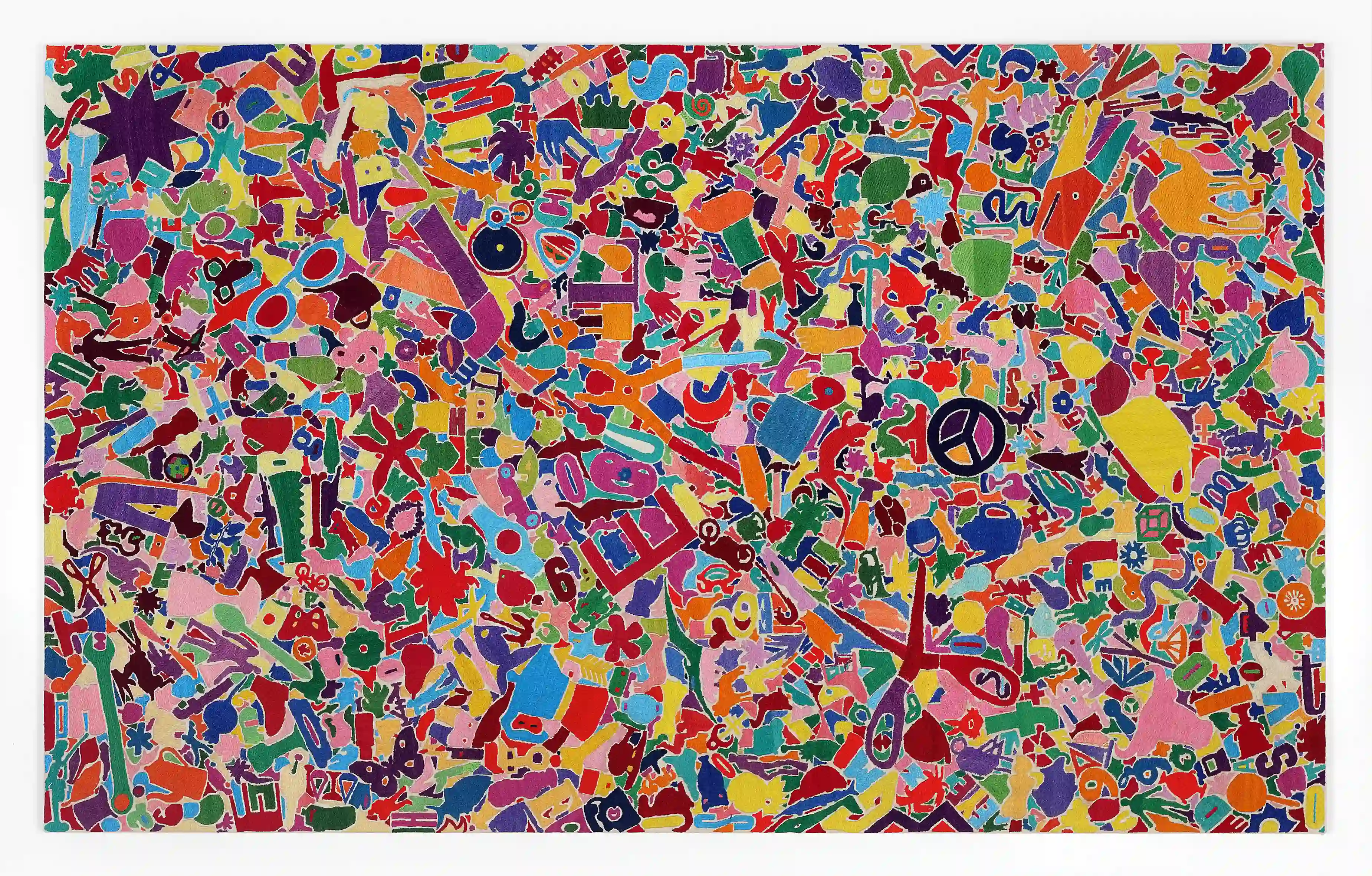
The title of the exhibition evokes the idea of a broad presentation of the artist’s research across nearly three decades of activity. At the same time, it explicitly alludes to the celebrated Tutto series, large textile compositions begun in the 1980s that juxtapose a dense weave of images and signs.
The exhibition begins with one of the founding groupings from Magazzino’s collection: a selection of artworks Boetti presented at his first solo exhibition at Christian Stein Gallery in Turin in 1967.
Right at the entrance, visitors encounter the original invitation card Boetti created for his debut show, where he affixed samples of the materials he had used to make the works (cork, electric wire, eternit, PVC, metal, plexiglass). The artist embraced the industrials materials emerging from the industrialization of Italian northern cities in the postwar period, which he sourced directly from the hardware stores. Among this first group of works—Triplo metro, Asta di misurazione, Mancorrente a squadra, Pannello luminoso, and Clino—offers privileged insight into the conceptual and aesthetic concerns that animated the artist’s early practice. Through essential structures, industrial materials, and everyday objects, Boetti challenges established categories such as measurement, function, authorship, and representation, revealing the conceptual potential of technical tools and common forms.
Two large works anchoring the first gallery emphasize the sculptural dimension of Boetti’s research during his formative years. Pavimento luminoso (1966), a painted wooden structure with a concealed internal lighting system, laid on the floor like a platform, questions the boundaries between object, architecture, and sculpture, materializing light within an essential geometric form. The work engages with the cultural context of 1960s Turin, recalling the illuminated floors of the Piper Club a central site of experimental artistic activity frequented by Arte Povera artists. Mazzo di tubi (1966) introduces a different type of intervention into industrial matter. The work consists of sixteen PVC pipes assembled vertically to evoke the form of a column. By reorganizing prefabricated elements, Boetti redefines the function and perception of objects typically hidden within a building’s technical spaces. This gesture transforms the composition into an autonomous spatial structure, shifting attention from manual execution to selection, assembly, and the redefinition of meaning. Central themes of Boetti’s work emerge here, including an interest in systems and classifications, the tension between order and variation, and the possibility of generating meaning through simple rules and structured processes. At the same time, these works testify to the experimental climate of Turin in the second half of the 1960s and Boetti’s dialogue with the emerging Arte Povera movement, whose lines of inquiry he helped define.
This early phase is followed by a series of works representative of Boetti’s Roman years, when his research expanded in multiple directions, increasingly focusing on themes of duality, authorship, and delegated execution. Exemplary of this phase is Da mille a mille (1975), composed of eleven sheets of graph paper on which the artist’s assistants were free to color and combine the squares according to their own choices. The work challenges the traditional notion of authorship as the expression of a single will, transforming the artwork into an open field where the final result emerges from the interaction between rule and freedom.
Also included in this section is a Mappa from 1983, part of the celebrated series begun after Boetti’s first trip to Afghanistan in 1971. Struck by the textile craftsmanship of Afghan women, the artist initiated a long-term collaboration, entrusting the production of these embroidered works to their extraordinary technical skill. The Mappe combine a high level of craftsmanship with minimal intervention by the artist: the composition derives from pre-existing systems—geographical borders and national flags—translated into textile through the artisans’ expertise. As in the Tutto series, Boetti brings together conceptual rigor and openness to contributions, transforming an apparently objective structure like the map into an ever-changing image.
Tutto Boetti 1966–1993 aims to present a multifaceted view of Boetti’s artistic research, tracing its development from early experiments in Turin in the 1960s to the large-scale works of his maturity. The exhibition highlights the remarkable coherence of an artist who built his practice around systems, collaboration, and openness to the world, as well as his fundamental role in shaping many of the key themes of Arte Povera.
“This exhibition stems from Magazzino’s ongoing commitment to developing an increasingly precise understanding of our collection,” explains Nicola Lucchi, Director of Magazzino Italian Art. “We are preparing guided tours and educational workshops for schools that will accompany this project, expanding its educational reach. We also look forward with particular interest to the publication of the catalogue, which will allow us to further consolidate and disseminate this line of research.”
Nancy Olnick and Giorgio Spanu, co-founders of Magazzino Italian Art, state: “The historic nucleus of works by Alighiero Boetti presented here, brought together thanks to the important relationship we have developed over the years with Gianfranco Benedetti from Galleria Christian Stein, now allows for a full critical reassessment of a foundational moment in the artist’s career and in the history of Arte Povera. We are also very pleased with the collaboration of the Fondazione Alighiero e Boetti for the symposium and of all those who made significant loans possible, contributing in a substantial way to the completeness of the exhibition project.”
About Alighiero Boetti
Alighiero Fabrizio Boetti (Turin, 1940 – Rome, 1994) was born on December 16, 1940, in Turin to Corrado Boetti, a lawyer, and Adelina Marchisio, a violinist. After abandoning his studies in Economics and Business at the University of Turin, he approached art as a self-taught artist, engaging with the vibrant cultural climate of Turin. He read Cesare Pavese, Eugenio Montale, Thomas Mann, William Faulkner, and Hermann Hesse. He looked to American Expressionism, the Spatialism of Lucio Fontana, and the works of artists such as Henri Michaux and Giacomo Balla. In 1962, he meets Annemarie Sauzeau, who will become his wife in 1964 and will distinguish herself as an art critic. Together with her, he moved to Paris between 1963 and 1964, where he studied printmaking with Johnny Friedlaender and deepened his engagement with the work of Nicolas de Staël, Jean Dubuffet, and André Malraux. His first solo exhibition, organized in January 1967 at the Christian Stein gallery in Turin, presented sculptures made from industrial objects and everyday materials. His attention to the intrinsic value of materials and their capacity to generate meaning led critic Germano Celant to include Boetti in the Arte Povera movement, theorized and published in Flash Art in the same year. Also in 1967, Celant invited Boetti to the seminal exhibitions Arte povera–IM spazio at La Bertesca gallery in Genoa and, in 1968, Arte Povera + Azioni Povere at the Ancient Arsenals of the Republic of Amalfi: the latter marked both the peak of his involvement in the movement and, at the same time, its conceptual overcoming. In 1969, he participated in the influential exhibition Live in Your Head: When Attitudes Become Forms (1969), curated by Harald Szeemann in Bern, London, and Krefeld. In 1974, he held his first solo exhibition in a public institution at the Kunstmuseum in Lucerne. During these years, Boetti began to explore the theme of identity, particularly the concept of duality expressed through the signature “Alighiero e Boetti.” Between 1969 and 1970, he initiated the Viaggi postali (Postal Journeys), through which he explored the temporal and spatial life of the artwork and redefined traditional notions of authorship. In the early 1970s, together with Annemarie Sauzeau, he began mapping the world’s major waterways, culminating in the artist’s book Classifying The Thousand Longest Rivers in the World (1977) and in a series of embroideries. Between 1971 and 1979, Boetti traveled frequently to Afghanistan, especially Kabul, where he took over the One Hotel, managing it together with Gholam Dastaghir. It became both his residence and a place of production. Here he developed his iconic textile works—the Mappe—commissioned from Afghan embroiderers. With the Soviet invasion in 1979, production was interrupted for several years, resuming in 1983 not in Kabul but in Peshawar, Pakistan, where some Afghan artisans had taken refuge and where the first works of the Tutto series were produced. In 1972, he moved to Rome and established his studio in Piazza Sant’Apollonia, in the Trastevere district. There he developed his ballpoint pen works—surfaces entirely filled with pen strokes that generate dense, vibrant chromatic fields, created using a common and inexpensive tool. In the same year, he participated in Documenta 5 in Kassel and exhibited for the first time in New York in the group show De Europa at the John Weber Gallery. The following year he had a solo exhibition at the Gian Enzo Sperone gallery, also in New York, and was invited to the 10th National Quadriennale of Art in Rome. In 1975, he participated in the group exhibition Eight Contemporary Artists at MoMA and, at the beginning of the same year, returned to New York for another exhibition at John Weber. In 1978, the Kunsthalle Basel dedicated a retrospective to him curated by Jean-Christophe Ammann. In 1985, Boetti traveled to Tokyo, where he became interested in shodō, the art of Japanese calligraphy, collaborating with master Enomoto San. In 1993, at Le Magasin Centre National d’Art Contemporain in Grenoble, in an exhibition curated by Adelina von Fürstenberg, he presented two monumental and choral works: the postal work De bouche à oreille, created in collaboration with the Musée de La Poste of Paris, and the installation Alternating from One to One Hundred and Vice Versa, featuring fifty kilims made from designs developed in various French art schools according to a system devised by the artist. Boetti died in Rome on April 24, 1994. In the final months of his life, he conceived the project Worlds Envisioned, created in dialogue with the artist Frédéric Bruly Bouabré and presented posthumously from October 1994 to June 1995 at the Dia Art Foundation in New York. After his death, Boetti’s work has been celebrated with international retrospective exhibitions: Galleria Nazionale d’Arte Moderna, Rome (1996); Museum für Moderne Kunst, Vienna (1997); Museum für Moderne Kunst, Frankfurt (1998); Whitechapel Gallery, London (1999); and Kunstmuseum Liechtenstein, Vaduz (2005). In 2001, on the occasion of the 49th Venice Biennale, the Italian Pavilion paid him a posthumous tribute. One of the most significant retrospectives, Game Plan, traveled between Museo Reina Sofía in Madrid (2011–2012), Tate Modern in London (2012), and MoMA in New York (2012)